 SnapDictate
How to verify AI code changes before you accept them
Turn each approved requirement into an observable check, run that check against the changed version, and record what happened. Check important preserved behavior too. Ask for the environment, evidence, and untested limits behind a completion claim. “The code was edited,” “the build passed,” and “the requested behavior works” are different statements.
Verification should be proportional to the change, but it should establish the outcome you are accepting.
Start with the approved request, not the agent's summary
An agent's completion message may describe what it chose to do rather than everything you asked for. Compare the result with the approved request and its sources.
In Pinecone Bookings, a fictional scheduling app, the approved change is to add a confirmation before canceling a reservation. Choosing Keep reservation should leave it intact. Choosing Cancel reservation should cancel only that test reservation.
A vague acceptance request is:
Check that the new cancellation popup looks good.
Appearance matters, but it does not establish either action. A better request is:
Check both choices using test reservations. Keep reservation must leave the booking active. Cancel reservation must cancel the selected booking only. Inspect the dialog's wording and narrow-screen layout separately.
The checks follow the requirement rather than the implementation details the agent happens to mention.
Distinguish the evidence you have
Different artifacts answer different questions. A code diff can show what changed. A successful build can show that a particular build process completed. A screenshot can show a rendered state. An interaction check can provide evidence of what happened after an action.
Do not use one as a substitute for all the others. A button can render correctly and call the wrong action. A test can pass while never exercising the behavior in your request.
Playwright's testing guidance emphasizes user-visible behavior rather than incidental implementation details. Read its testing philosophy. You can apply that principle to manual checks too: define what the person using the app should observe.
Make an acceptance matrix
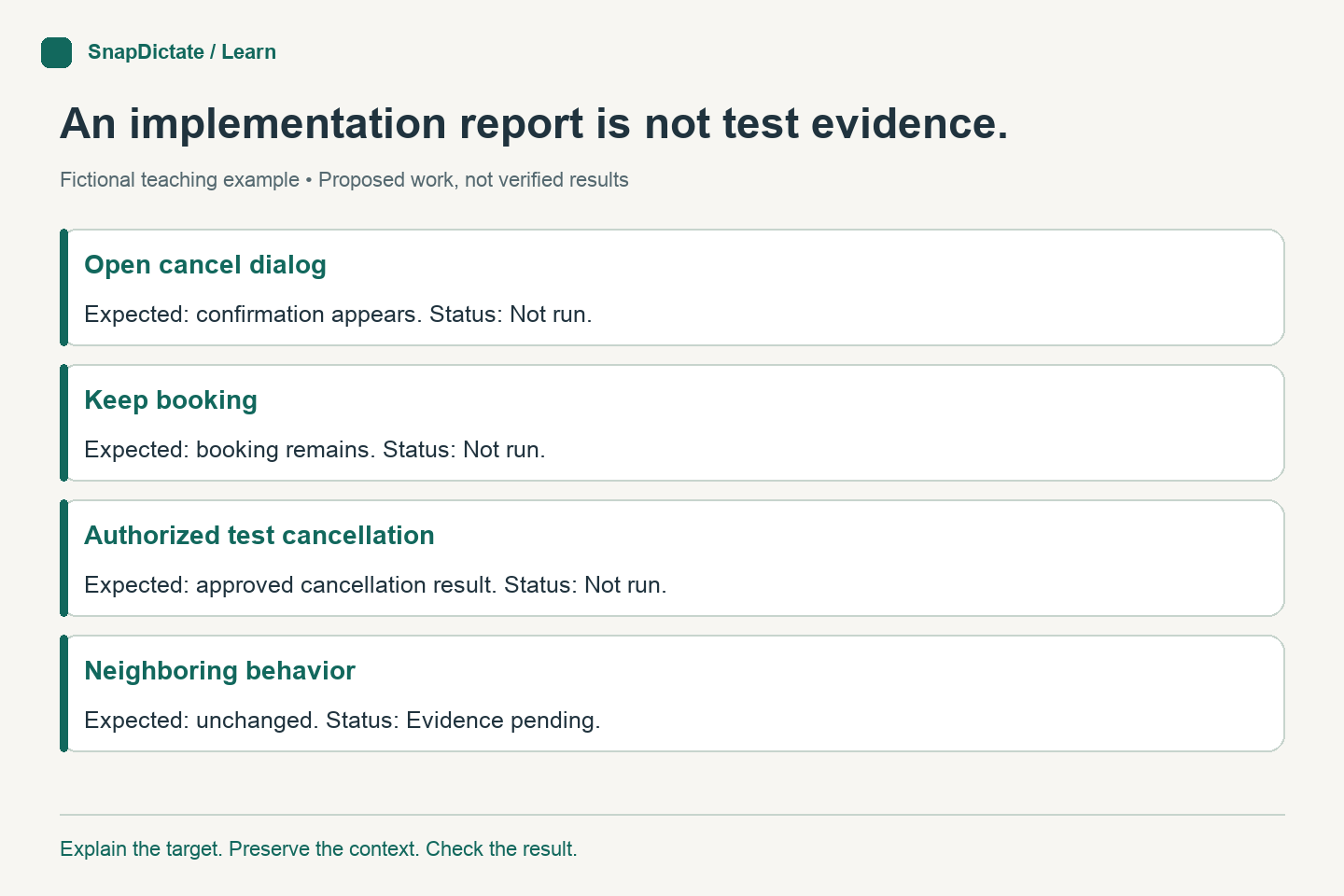
Here is a proposed matrix for the fictional cancellation change. It contains planned checks, not completed test results.
| Requirement | Starting state and action | Expected result | Status before testing |
|---|---|---|---|
| Ask before canceling | Open an active test reservation and select Cancel | Confirmation dialog appears; reservation remains active | Not checked |
| Preserve the reservation | Select Keep reservation | Dialog closes; the same reservation remains active | Not checked |
| Cancel the selected reservation | Confirm cancellation for an approved test booking | That reservation becomes canceled; unrelated bookings remain unchanged | Not checked |
| Keep the dialog usable | Open the dialog at the agreed narrow viewport | Text and both controls remain visible and usable | Not checked |
| Handle failure honestly | Use the project's approved failure-test method | Failure is reported without falsely claiming cancellation | Not checked |
The failure check needs an authorized method. Do not manufacture failures in production or interrupt a live service just to fill a row in a checklist.
For a source-linked task record, use the implementation checklist guide.
Define the test boundary before acting
Identify the environment, version, account role, and data you are permitted to use. Make clear whether the test may send a message, delete a record, cancel a booking, or trigger an external service.
For Pinecone Bookings, use disposable test reservations in an approved test environment. Do not infer that an instruction to verify a dialog authorizes canceling a real customer's booking.
If the agent lacks appropriate access, it can inspect the implementation and describe the remaining checks. Those observations are useful, but the blocked interactions must stay blocked. A request for verification is not permission to bypass access controls.
Record the version or preview reference before the check so the evidence can be tied to the change being accepted.
Copy this verification request
Compare the implementation with the approved request and its sources.
Do not rely only on your previous completion summary.

For each requirement:
- State the observable acceptance check.
- Identify the environment and version being checked.
- Use only authorized test accounts and data.
- Record expected and actual results.
- Provide the evidence reference or relevant test output.
- Mark Passed, Failed, Blocked, or Not checked.

Check the important behavior we explicitly asked to preserve.
Distinguish code inspection, automated checks, rendered screenshots,
and interaction tests. Do not describe an unperformed check as passed.

Do not publish, charge, send live messages, or modify production records
unless that action has separate explicit authorization.

Finish with the remaining risks or limits that affect acceptance.
This template asks for evidence, not a longer success message. The agent should be able to report a failed or blocked check without disguising it as a completed task.
Run a focused before-and-after check when practical
For a bug fix, reproducing the original failure gives the repair a meaningful target. Then repeat the same scenario after the change. Keep the relevant state and test data consistent unless the approved task requires changing them.
When you cannot run the before state, say so. You can still test the expected behavior after the change, but you should not claim to have demonstrated that a particular edit caused the improvement.
The reproducible bug-report guide explains how to record the original scenario. Do not silently simplify that scenario until the test passes; you may have removed the condition that exposed the bug.
Check preserved behavior without testing the entire product
Choose preservation checks based on the affected outcome and plausible dependencies. The cancellation dialog needs both branches checked, the selected reservation's state inspected, and nearby behavior reviewed when the edited code could affect it.
It does not automatically require a complete audit of every page. A small wording correction may need an exact-text check and a layout spot-check. A change to shared authorization or data-handling logic warrants a broader test plan than a label replacement.
Ask the implementer to explain that scope in concrete terms: what changed, what depends on it, and which checks cover the risk. “I tested everything” is not a substitute for a defined scope.
Read the result as an evidence record
A useful record has these fields:
Requirement ID:
Environment and version:
Starting state:
Action performed:
Expected result:
Actual result:
Evidence reference:
Status:
Limitations or next action:
If the dialog renders but the cancellation service is unavailable, separate those results. The visual check may pass while the action check remains blocked. Do not let a successful screenshot make the whole requirement appear verified.
When a check fails, request a repair for that specific discrepancy and rerun the affected checks. Preserve successful work unless inspection shows it is part of the problem.
Accept the tested scope, not an unlimited guarantee
Verification supports the scenarios, version, and environment actually checked. It does not prove that no defect exists anywhere in the application. State meaningful limits without making every small change sound impossible to accept.
Once the agreed checks pass, update the current record and proceed through the normal review or release process. If another agent takes over, carry the evidence and open checks into the handoff document.
SnapDictate can supply the original narrated or written request and screenshots used to define the checks. It does not run those checks or automatically verify implementation. Keep the review as a source and attach the separate test evidence to the task. See the review workflow.
Verification questions
Is a passing build enough for a wording change?
It does not establish that the intended wording appears in the correct place. Inspect that result. Add other checks only where the change could affect wrapping, behavior, or shared content.
Can the same agent implement and test the change?
Yes, but evaluate the evidence rather than treating its self-assessment as independent confirmation. For consequential changes, an additional reviewer or independent check may be appropriate.
What should I do with a blocked check?
Name the missing access, data, tool, or environment and leave the check open. Decide whether that limit prevents acceptance. Do not convert Blocked into Passed merely to close the task.
Sources
Published by SnapDictate / RepX Inc., the maker of the product mentioned here. About and corrections.