 SnapDictate
How to split a long AI feedback review into useful tasks
Separate approved changes by outcome, identify dependencies, and choose an order based on what blocks the next useful result. Group changes that must be implemented and checked together; separate unrelated work. Give each task its own acceptance check and preservation rules. The order in which you noticed problems does not have to be the order in which an agent fixes them.
This is a sequencing method for an existing app, not an invitation to turn every observation into a feature.
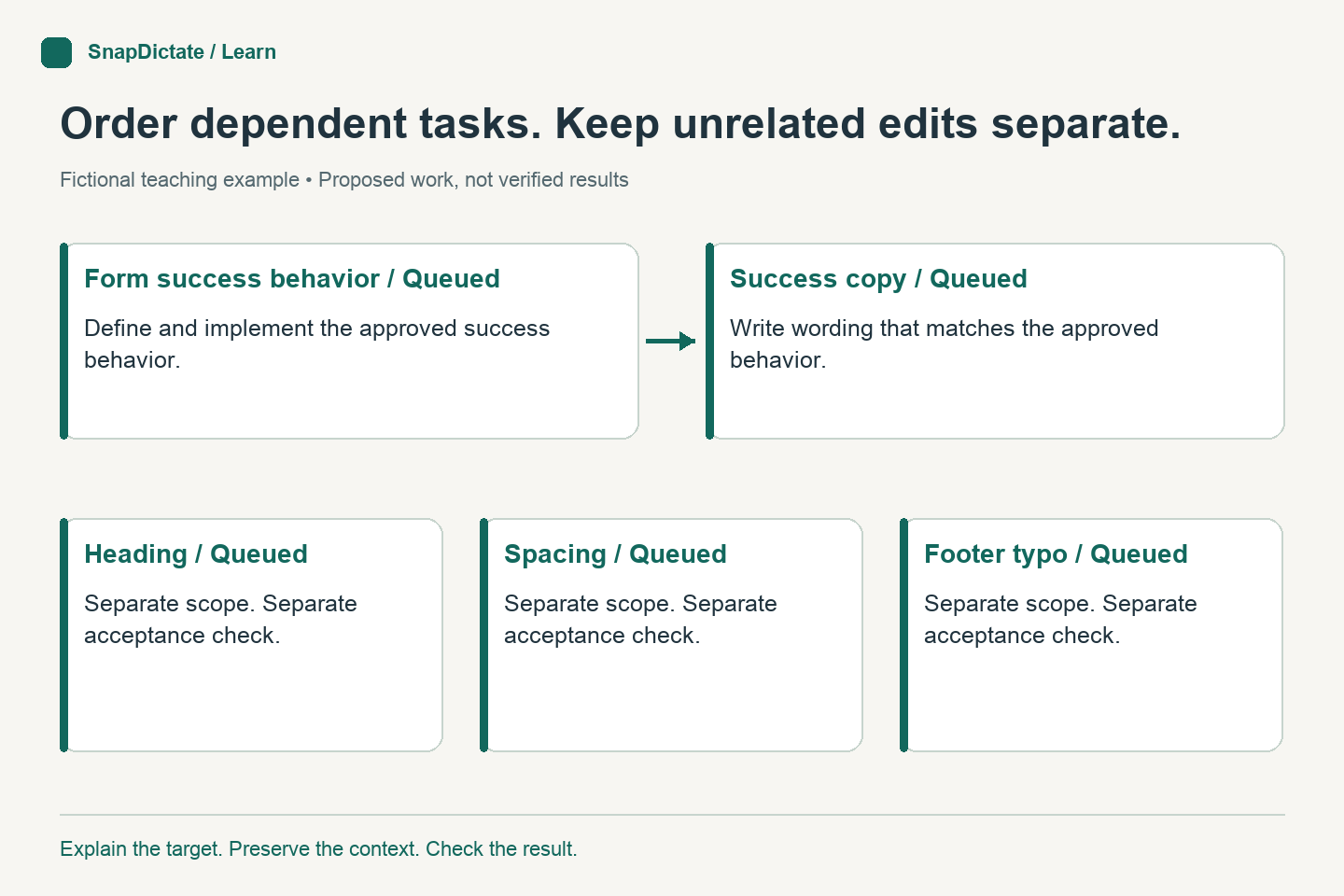
First extract the requests; then decide their order
A transcript can mix requirements, questions, and observations. Resolve that extraction problem before prioritizing. Otherwise, an unapproved idea can become the first task merely because it sounds urgent.
The implementation checklist method explains how to identify source-backed tasks. This article starts after that step: you have a set of approved outcomes and need to decide how the work should proceed.
Keep uncertain items visible, but do not schedule them as settled requirements. A question such as “Should the form collect a phone number?” needs a decision before it becomes “Add a phone-number field.”
A fictional review with five approved changes
Atlas Classes is a fictional workshop website. Its owner approves five changes during a review:
The main heading needs new wording. The signup form currently shows success when a submission fails. The footer contains a spelling error. The successful-submission message needs an approved replacement. The narrow-screen gap beneath the heading needs adjustment after the new wording is in place.
A vague handoff says:
Fix all five things and make the website consistent.
That bundles a behavior defect, two copy corrections, a dependent message change, and a layout adjustment into an undefined redesign. “Consistent” adds scope without specifying a result.
A useful queue identifies the dependencies:
| ID | Approved outcome | Dependency | Proposed order and reason |
|---|---|---|---|
| AC-01 | Show success only for accepted signup submissions | Investigate the existing success/failure handling | First: establishes correct submission outcomes |
| AC-02 | Replace the successful-submission message | AC-01 establishes which state is truly successful | With or after AC-01, with a separate text check |
| AC-03 | Replace the main heading | None identified | Independent copy task |
| AC-04 | Adjust the gap beneath the heading on narrow screens | AC-03 supplies the final text and wrapping | After AC-03 |
| AC-05 | Correct the footer spelling | None identified | Independent small correction |
This is a proposed order for the fictional example, not a universal priority system. A real release deadline, dependency, or user impact may change it. Record the reason rather than presenting a guessed priority as a fact from the review.
Group by shared outcome, not by how close items appear
AC-01 and AC-02 belong to the same submission outcome. It may be practical to implement them together while checking the behavior and exact wording separately.
AC-03 and AC-04 form another small group: the new heading affects the layout being adjusted. Measuring spacing before applying the final text could produce a result that needs rechecking immediately.
The footer typo is independent. It does not need to wait for a complete form investigation, but it should not distract from resolving the form's incorrect success state.
Two changes on the same page may be unrelated. Two changes in different files may be tightly connected. Ask the agent to identify dependencies in the existing implementation rather than assuming that visual proximity equals technical coupling.
Replit's prompting guidance recommends logical stages and incremental work. See its planning guidance. The grouping method here applies that general idea to a set of approved corrections, without prescribing Replit-specific controls.
Give each task a clear finish line
A queue entry should say more than “fix form.” Define the outcome and the check before assigning the order.
For AC-01: an accepted test submission shows success; an approved failure test shows the failure state instead. For AC-02: the approved message appears only in the genuine success state. For AC-04: the final heading and following section remain readable and separated at the agreed narrow viewport.
The five-part request template supplies the fields for each bounded task. Shared preservation rules can sit above the group, but task-specific checks should remain attached to their IDs.
Do not mark an entire group complete when only its easiest item passed. A footer typo does not establish that the form behavior is correct.
Copy this task-order request
Use the existing approved checklist. Do not create a competing master list.

Before implementation:
1. Identify dependencies among the approved items.
2. Propose small groups that share an outcome or require joint testing.
3. Separate independent changes and unresolved decisions.
4. State the proposed order and the reason for each dependency.

For each group, preserve:
[Shared behavior, content, styling, and data rules.]

For each item, retain:
Its ID, source, exact requested outcome, and acceptance check.

Implement the authorized group, then report item-level results.
Do not expand “consistency” or “cleanup” into an unrelated redesign.
Record newly discovered work as Proposed unless it is already within
the approved scope. Ask when a necessary dependency changes that scope.

Stop at the requested boundary. State the next eligible task and any
blocker without claiming unfinished items are complete.
Adjust the authorization line to your actual arrangement. A request to propose the order does not automatically authorize implementing all the groups.
Keep priority separate from dependency
Priority says which outcome matters most. Dependency says which work must precede another item. They can point in different directions.
The narrow-screen layout might be the most visible concern, but it still depends on the final heading text. Applying that text first is not a decision that copy is more important than usability. It is an implementation order that supports a stable check.
Similarly, a high-priority task can remain blocked while an independent lower-priority task proceeds. Record the blocker and the reason for doing the independent work. Do not quietly redefine the blocked task as complete to make the queue look clean.
Avoid invented severity labels. If a report says only that something looks wrong, investigate its impact before calling it critical.
Do not turn every task into a separate conversation
One task at a time is not the same as one conversation per task. Related corrections can benefit from the same project context and shared references. What matters is that the current scope and status remain clear.
Use separate workstreams when the tasks are genuinely independent and the workflow supports them. If several agents edit the same shared component, establish ownership and integration checks rather than assuming parallel work is automatically faster or safer.
The queue should make coordination visible, not create administrative work that exceeds the correction itself.
Review a group before moving on
After a group is implemented, check its own acceptance criteria and relevant preserved behavior. Then update the existing record. AC-01 may be implemented but blocked on an authorized failure test; AC-02 may have passed its exact-text check. Keep both facts.
Use the verification guide to decide what evidence is sufficient. If the work changes conversations, carry the current queue and its dependencies into the agent handoff document.
SnapDictate can keep a multi-part spoken or written review and its screenshots in order. That capture order preserves context; the receiving agent and project owner still decide the implementation order. Its proposed checklist is a starting point, not automatic prioritization. See the review handoff.
Task-order questions
Should every request contain only one change?
No. Group changes when they share a clear outcome or need joint testing. Separate unrelated work and give each item an identifiable acceptance check.
Can I ask the agent to choose priorities?
You can ask for a proposal with reasons. Provide actual user impact, deadlines, and dependencies when known. Treat unsupported assumptions about importance as assumptions, not approved business priorities.
What if a task reveals more work than expected?
Identify the new dependency and whether it is necessary for the approved outcome. Ask for a scope decision where needed. Keep optional improvements outside the current task rather than absorbing them into “cleanup.”
Sources
Published by SnapDictate / RepX Inc., the maker of the product mentioned here. About and corrections.